Fly Agaric: A Deep Dive into History, Healing Arts, and Ecology
The fly agaric has fascinated for centuries: cultural history, folk medicine, ritual use, and ecological role – an in-depth species article.
The fly agaric (Amanita muscaria) is arguably the most famous mushroom in the world – a red-and-white symbol that adorns kindergartens and is deeply rooted in cultural history, healing arts, and ritual practice. This article goes far beyond a simple profile: it illuminates the biological characteristics, historical and ethnological significance, traditional folk medicine, psychoactive compounds, and ecological role of the mushroom. We also take a look at the FungiFind Mushroom Map, which shows where the fly agaric currently occurs – and how its distribution is changing with climate change.
Characteristics and Identification
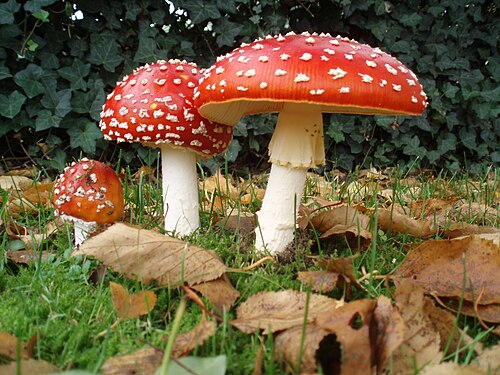
The fly agaric is unmistakable – at least to the trained eye. Its cap reaches 8 to 20 centimeters in diameter, is bright red to orange-red, and covered with white warts that are remnants of the universal veil. Young fruiting bodies have a spherical cap, later convex, and finally flattened. The gills are white, crowded, and not attached to the stem. The stem is white, up to 20 centimeters tall, bulbous at the base, and bears a hanging white ring (annulus). The bulb is surrounded by several warty veil remnants – an important distinguishing feature.
Confusion is most likely with the royal fly agaric (Amanita regalis), which is also reddish-brown but often lacks distinct warts. The panther cap (Amanita pantherina) is also similar, but has a brown cap with white flakes and a non-striate ring. The blusher (Amanita rubescens) has a gray-brown cap with reddish spots and turns yellow when bruised – a reliable difference. For laypeople, identification without field guides or expert advice is not recommended; even mere skin contact can cause irritation in sensitive individuals. A look at the FungiFind Species Lexicon offers initial orientation but does not replace professional consultation.
Historical Significance and Cultural History
The fly agaric has an extraordinary cultural history dating back to antiquity. In Northern and Eastern Europe, it was likely the subject of myths and rites even in pre-Christian times. Particularly famous is the theory of ethnomycologist R. Gordon Wasson, who speculated that the fly agaric was the mystical drink "Soma" of the Indian Rigveda hymns – a thesis still debated today. Wasson, a banker and amateur researcher, undertook expeditions to Mexico and Siberia and documented ritual mushroom use. His works, such as "Soma: Divine Mushroom of Immortality" (1968), shaped ethnomycology as a science.
In Siberia, especially among the Koryaks and Chukchi, the fly agaric was traditionally used in shamanic ceremonies. Shamans consumed the mushroom to enter trance states and communicate with spirits. The mushrooms were dried and often eaten by the shamans, while the community participated in the rituals. Interestingly, ethnologists report that the urine of individuals who had consumed fly agarics was also psychoactive – a phenomenon utilized by Siberian peoples to prolong and amplify the effects.
In European folk culture, the fly agaric appears in fairy tales, legends, and images. It is considered a lucky charm and is inextricably linked to the image of Santa Claus: the red-and-white clothing of Santa Claus is traced by some cultural historians to shamanic traditions where fly agarics were distributed as gifts. The mushroom also appears frequently in art, from Albrecht Dürer to modern pop culture – from "Alice in Wonderland" to video games. The red cap with white dots is an archetype that extends far beyond botanical reality.
Traditional Healing Arts / Folk Medicine
In folk medicine, the fly agaric – historically speaking – was used in various ways, though a clear separation between magical and medical application is often impossible. In European herbal medicine of the Middle Ages and early modern period, it was considered a remedy for external inflammations, joint pain, and even as a wound healer. Records from the 16th century mention that crushed mushrooms were applied to wounds or aching joints – presumably due to the skin-irritating effect that created a kind of "counter-irritation." This use is purely historical; it is now obsolete and dangerous.
In traditional Chinese medicine (TCM), the fly agaric is rarely mentioned, but in some ethnobotanical reports from North Asia, it is cited as a tonic or to strengthen during exhaustion. Here too: there is no scientifically proven therapeutic application that withstands the risks. The compounds ibotenic acid and muscimol act on the central nervous system; controlled dosing is impossible because the content varies greatly depending on location, season, and individual mushroom. Modern research, however, is investigating whether muscimol could serve as a template for medications against anxiety or sleep disorders – but only in synthetic form and under strict clinical control.
For folk medicine, the fly agaric is thus a historical example of dealing with psychoactive substances, without any direct transfer to current therapies being possible. The FungiFind Blog has repeatedly pointed out in its series "Mushrooms and Climate Change" that such traditional uses must not be trivialized – and that any form of self-medication with wild mushrooms can be life-threatening.
Active Compounds, Risks, and Ritual Use (Educational Only)
The fly agaric contains a range of compounds responsible for its psychoactive properties: ibotenic acid and its decarboxylation product muscimol. Ibotenic acid is neurotoxic and excitatory, while muscimol has a sedative, hallucinogenic effect. The concentration varies greatly – depending on region, age of the mushroom, and drying process. After oral ingestion, effects begin within 30 to 90 minutes and can last up to six hours. Typical effects include confusion, euphoria, altered sensory perception, but also nausea, vomiting, and muscle twitching. In high doses, seizures and unconsciousness can occur – poisoning is a medical emergency.
Historically, the fly agaric was used as an intoxicant in shamanic rituals in Siberia and other regions. Shamans consumed the mushroom to enter trance, experience visions, and communicate with the spirit world. The use was strictly ritual: mushrooms were often dried to control the effect, and the urine of consumers was reused to prolong the effect – a cycle well documented in ethnological reports. In Northern Europe, there is also evidence of ritual use, such as among the Sami, where the mushroom was associated with reindeer herding – reindeer eat the mushrooms and then exhibit strange behavior that fascinated people.
Legal notice: In Germany, possession and consumption of fly agarics are not explicitly prohibited, but dealing with psychoactive substances is legally sensitive. The sale of fly agarics as an intoxicant is prohibited, and consumption is a health risk. This article is for educational and informational purposes only; it contains no instructions for procurement, dosing, or use. In case of poisoning, contact the poison control center or an emergency doctor immediately.
Ecology, Habitat, and Distribution
The fly agaric is a mycorrhizal fungus that lives in symbiosis with deciduous and coniferous trees – especially birches, pines, spruces, and firs. It forms a dense network of fungal threads around the roots, improving nutrient uptake for the trees and receiving carbohydrates in return. This symbiosis makes it an important component of forest ecosystems. It prefers acidic, nutrient-poor soils and is commonly found in open woods, forest edges, and clearings. Fruiting bodies appear from June to November, often in groups or rings.
Its distribution spans the temperate and boreal zones of the Northern Hemisphere – from Europe through Asia to North America. In recent decades, it has also been introduced to the Southern Hemisphere, such as Australia, New Zealand, and South Africa, where it spreads with introduced tree species. The GBIF database documents occurrences on all continents except Antarctica. This global spread is an example of how fungi conquer new habitats through human activity and global trade.
Season, Weather, and Relation to the FungiFind Mushroom Map
In Central Europe, fruiting bodies of the fly agaric typically appear from June to November, with a peak in August and September. Formation is favored by humid weather and temperatures between 10 and 20 degrees Celsius. After prolonged dry periods followed by rain, mass fruiting can occur – a phenomenon that delights mushroom foragers and nature enthusiasts alike. The FungiFind Mushroom Map shows current sightings from the community and helps track occurrences in your region.
Climate change also affects the fly agaric: in Southern Europe, it is becoming increasingly rare because summers are hotter and drier, while in Northern Europe and at higher elevations, it is colonizing new areas. A 2020 study (published in the journal "Fungal Ecology") predicts that the fly agaric's distribution could shift northward by up to 30 percent by 2050. These changes are a central theme of the series "Mushrooms and Climate Change" on the FungiFind Blog. The FungiFind Species Lexicon provides a detailed profile with seasonal data and distribution maps that are regularly updated.
Conclusion
The fly agaric is much more than a pretty photo subject. It combines ecological significance with a fascinating cultural history that ranges from shamanic rituals to modern pop culture. At the same time, it is a cautionary example of the risks of psychoactive mushrooms – and an indicator of the transformation of our forests under climate change. If you encounter it in nature, admire it, but do not touch or consume it. For safe identification and current find reports, we recommend the FungiFind Mushroom Map and the FungiFind Species Lexicon.
Note: This article is purely informational and does not replace professional mushroom advice. If poisoning is suspected, contact the poison control center immediately.
Sources & further reading
- Fliegenpilz – Wikipedia (wikipedia)
- GBIF – Amanita muscaria (research)
- R. Gordon Wasson – Ethnomykologie (wikipedia)
- FungiFind Artenlexikon (internal)