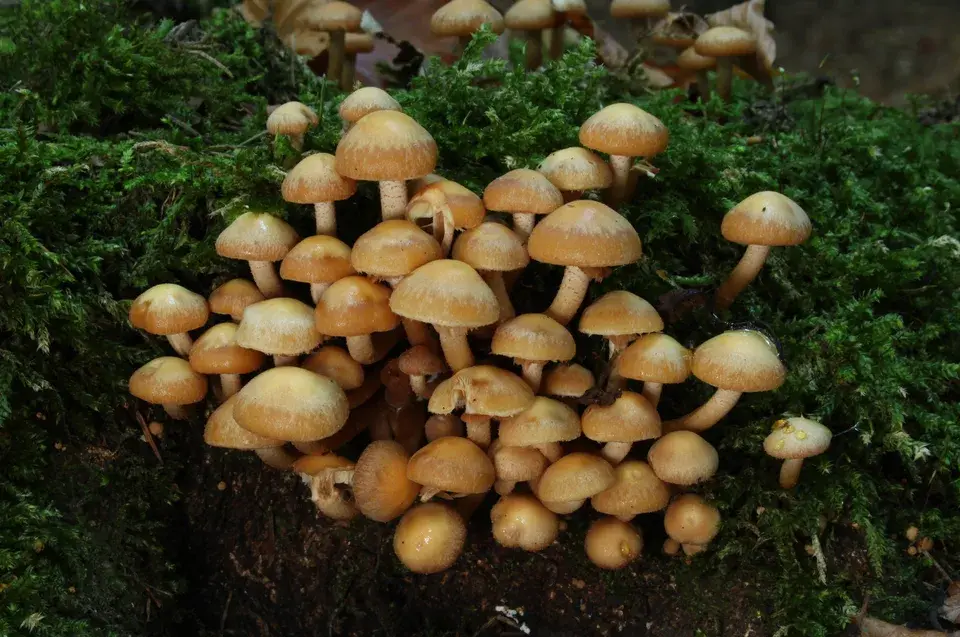
Velvet shank grows from October to March; host trees: grows on dead or weakened deciduous wood, often willow, poplar, ash and elm, also beech and elder. Edible, but only after a certain identification; this page does not replace an in-person check.
Illustration: FungiFind, created with AI. Not a substitute for identification.
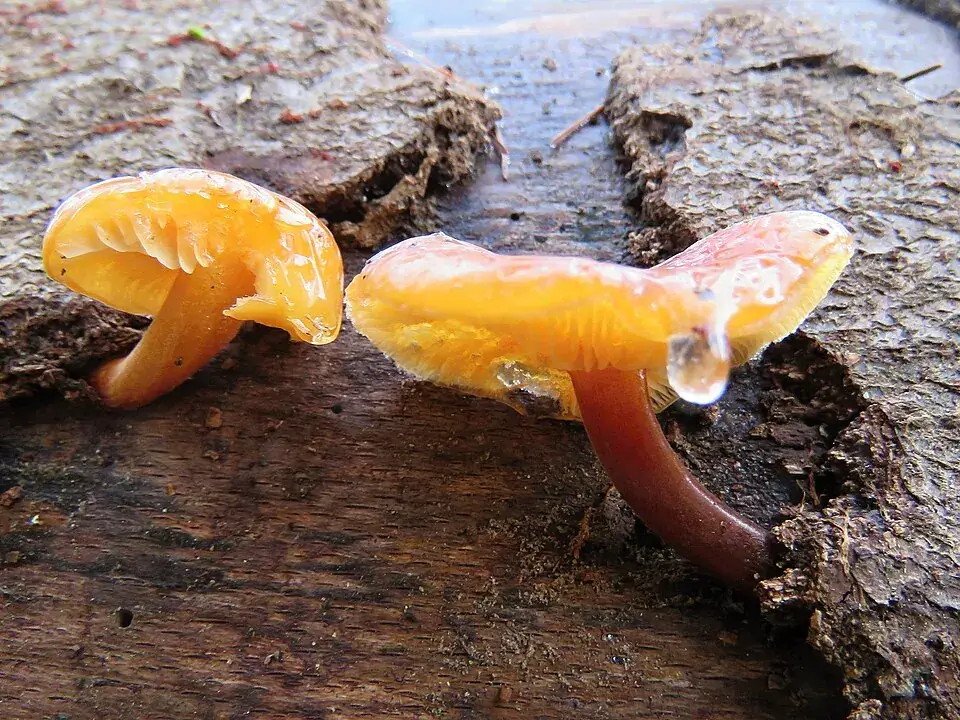
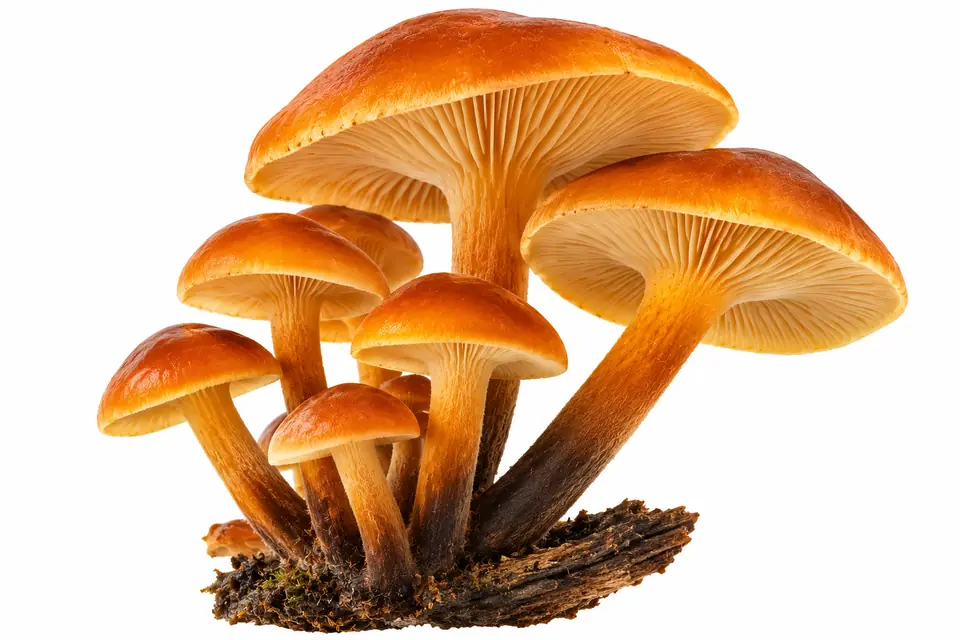
The velvet shank is an edible mushroom of the cold season. It grows in tufts on dead or weakened deciduous wood, has a greasy, shiny, orange-yellow to orange-brown cap and a velvety stem that turns dark brown to black towards the base. It has no ring. It can be mistaken for the deadly poisonous funeral bell.
SeasonOctober to March
Spore printwhite
FamilyPhysalacriaceae
Cap. The cap is 2 to 10 cm wide, honey yellow to orange-brown, darker towards the centre and paler at the edge. When damp it is greasy to slimy, when dry it is shiny.
Underside. The gills are whitish to pale yellowish and notched where they meet the stem. They stay pale and never turn rust-brown.
Stem, ring and volva. The stem is tough, yellowish at the top and velvety dark brown to black towards the base. It has no ring and no ring zone. Several stems are often joined at the base. There is no volva.
Smell and taste. It smells faintly mushroomy and tastes mild. A mealy smell does not fit this species.
Flesh and colour change. The flesh is thin, whitish to yellowish in the cap, brownish and tough in the stem. It does not change colour.
Lookalikes
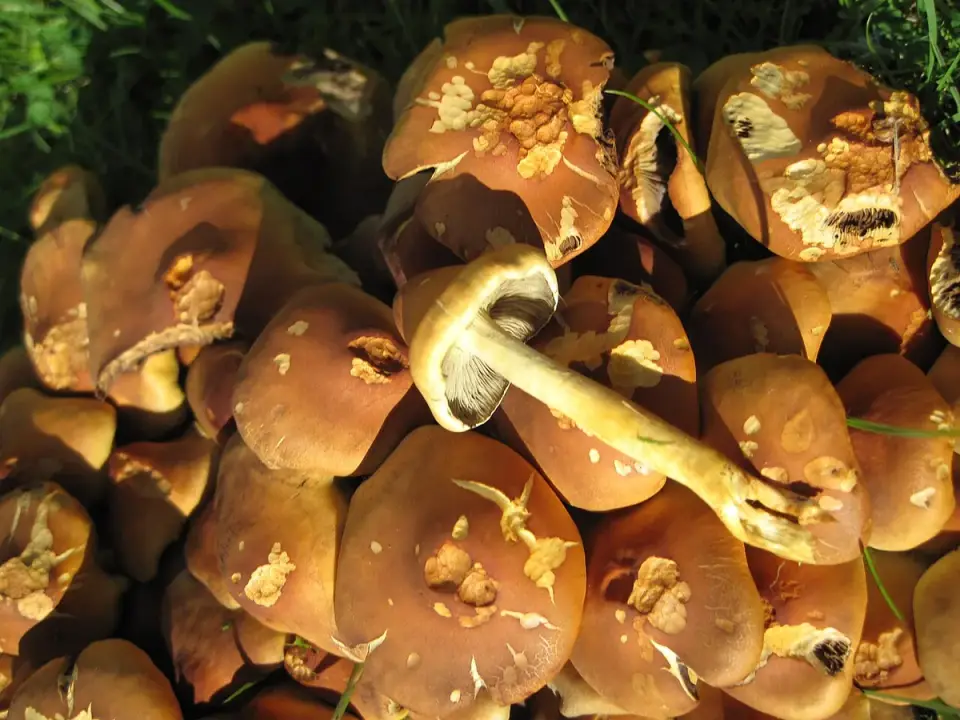
It grows in winter in tufts on deciduous wood and has a white spore print. The deadly poisonous funeral bell also grows in tufts on wood, into December, and has a rust-brown spore print. So always take a spore print and check every single mushroom.
It has a ring or at least a ring zone on the stem, and below the ring the stem is covered in silvery fibres. Its spore print is rust-brown, it smells mealy and grows mostly on conifer wood, but also on deciduous wood. The velvet shank has no ring, a velvety stem that turns dark brown to black towards the base, a white spore print and a greasy cap. Deadly poisonous. If in doubt, do not eat it.
Its cap is sulphur yellow, the gills are yellow to greenish and darken later, and its spore print is purple-brown. The stem is yellowish and not velvety, and it tastes very bitter. Poisonous, causes gastrointestinal upset.
honey to ochre brown, mostly small, shiny when damp
sulphur yellow, centre often orange
brownish yellow, hygrophanous
Underside
whitish to pale yellow, notched gills
pale ochre gills, later rust-brown
yellowish to olive-green gills
pale brownish gills, later cinnamon brown
Stem
no ring, velvety, dark brown to black at the base
ring or ring zone, silvery fibres below
yellowish, not velvety
with ring, scaly below
Flesh
cap soft, stem tough
thin-fleshed, mealy smell
thin-fleshed
thin-fleshed, stem fibrous
Edibility
Edible
deadly poisonous
poisonous
edible
Habitat & Season
In tufts on stumps, trunks and branches, also on living, weakened trees. No reliable information.
Host trees
Grows on dead or weakened deciduous wood, often willow, poplar, ash and elm, also beech and elder.
Season
Jan
Feb
Mar
Apr
May
Jun
Jul
Aug
Sep
Oct
Nov
Dec
possible good main season
It often appears only after the first frosts and tolerates frost. In mild winters you can find it all winter long.
Velvet shank on the map: where does it fit right now?
The map shows every day where weather, soil and forest currently suit this species. The stronger the orange, the better the conditions. Grey means unsuitable. With the day slider you can look up to 13 days ahead. The map shows grid cells, not exact spots.
Unfavourable
Moderate
Favourable
Very good
unsuitable
Velvet shank: today's chance of finds in a section of the map. The legend above explains the colours.
How good are the chances of finding this species where you are right now? We calculate it from weather, soil moisture, altitude and forest at your location.
Mushroom advice:DGfM: find a mushroom expert. Certified mushroom experts of the German Mycological Society (DGfM).
Collecting rules: Mushrooms that are not specially protected may be collected in small quantities for personal use unless a protected area or ban applies. Certain specially protected edible species (e.g. cep, chanterelle, birch bolete) may be collected in small quantities for personal use.
Collecting rules: At most 2 kg of mushrooms per person per day unless the forest owner has prohibited collecting; organised collecting events are prohibited. Additional state rules apply (collecting hours, closed seasons), e.g. Carinthia, Tyrol, Vorarlberg, Salzburg.
Conservation and collecting rules
Not specially protected.
In the kitchen
Use only the caps, the stems are tough. You can peel off the slimy cap skin. Good in soups, pan dishes and Asian dishes. Cook for at least 15 minutes.
No reliable information on drying. Risk of confusion with the deadly poisonous funeral bell. Take a spore print from every cluster. If the spore print is not white, eat none of it. Check every mushroom one by one for a ring and a velvety stem, because different species can grow on the same wood.
Never eat wild mushrooms raw, and always cook them for at least 15 minutes.
Use only young, fresh, maggot-free mushrooms that you have identified with certainty.
Carry mushrooms in an airy basket, not in plastic bags, and process them on the same day.
Frequently asked questions
Is the velvet shank edible?
Yes, the caps are a good edible mushroom. The stems are tough and are not eaten. Because it can be mistaken for the deadly poisonous funeral bell, you must identify every find with certainty.
How do you tell it apart from the funeral bell?
The velvet shank has no ring, a velvety stem that turns dark brown to black towards the base, and a white spore print. The funeral bell has a ring or ring zone, a rust-brown spore print and smells mealy. If in doubt, do not eat it and ask a mushroom advisor.
When and where do you find the velvet shank?
From October to March, often after frost, in tufts on stumps and trunks of deciduous trees such as willow and poplar.
Is the velvet shank the same as enoki from the supermarket?
No. The pale, long-stemmed enoki sold in shops belong to a closely related Asian species and are grown in the dark. The wild velvet shank, with its orange cap and dark stem, looks quite different.