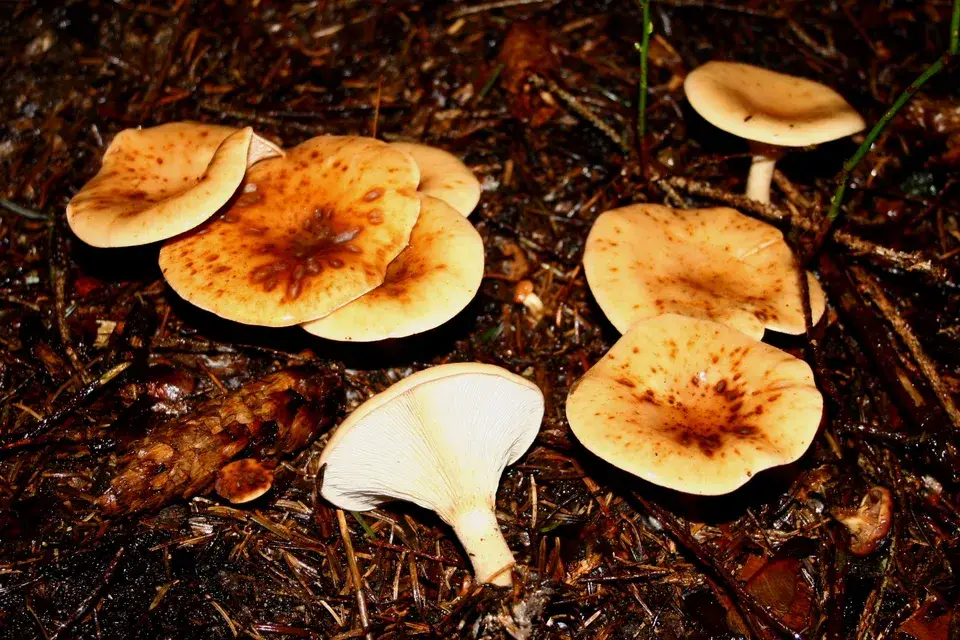
Paralepista gilva is a funnel cap, ochre-yellow to reddish, with concentric water spots on the cap. It resembles the tawny funnel cap and, like it, is considered edible, but it is sometimes described as indigestible and is hard to separate from poisonous species.
SeasonAugust to November
Spore printwhite
FamilyTricholomataceae
Cap. The cap is ochre-yellow, slightly paler than in the tawny funnel cap, funnel-shaped with a depression, and the margin is rolled in when young. Concentric water spots show on the cap, and the whole mushroom looks sturdier.
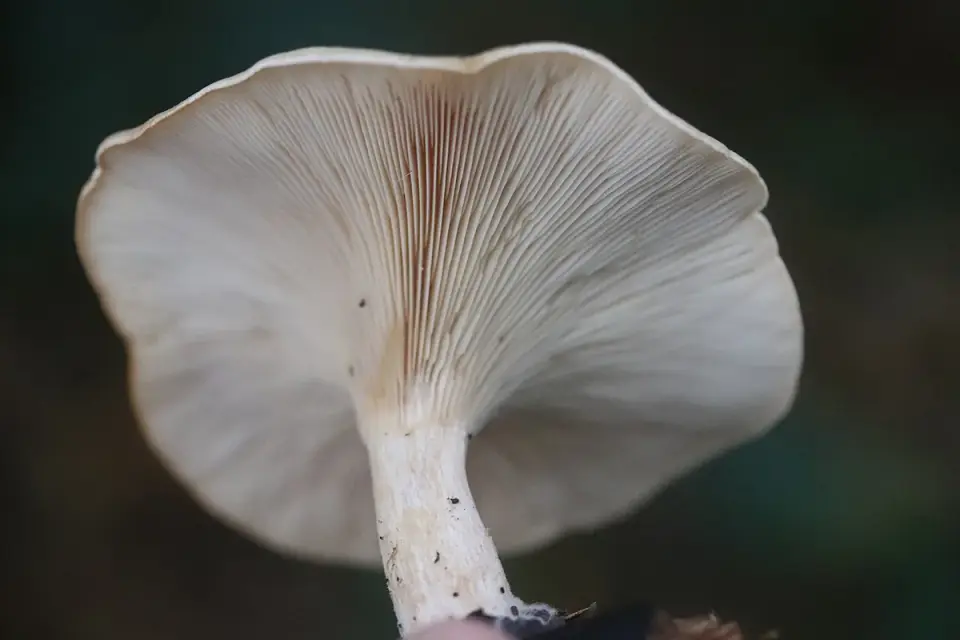
Underside. The crowded gills run clearly down the stem and can be peeled off the cap relatively easily, which is typical of Paralepista species.
Stem, ring and volva. The stem is tough, with a felt of mycelium at the base. There is no ring and no volva.
Smell and taste. The closely related tawny funnel cap smells woody and harsh; there is no more reliable information for Paralepista gilva.
Flesh and colour change. The flesh is pale and thin.
Lookalikes
Paralepista gilva is a funnel cap with a white spore print, and in the field it can hardly be told apart reliably from poisonous relatives. In south-western Europe it has already been mistaken for the paralysis funnel, which causes acromelalga syndrome. Only for confident experts.
It causes acromelalga syndrome and cannot be separated reliably from the Paralepista species in the field. There is hardly any safe field feature, so a find like this should be checked by a mushroom advisor.
It is red-brown to red-ochre and has no concentric water spots on the cap. The water spots are the distinguishing feature of Paralepista gilva. Both are considered edible, but in Switzerland the tawny funnel cap is no longer on the list of edible mushrooms.
How good are the chances of finding this species where you are right now? We calculate it from weather, soil moisture, altitude and forest at your location.
Mushroom advice:DGfM: find a mushroom expert. Certified mushroom experts of the German Mycological Society (DGfM).
Collecting rules: Mushrooms that are not specially protected may be collected in small quantities for personal use unless a protected area or ban applies. Certain specially protected edible species (e.g. cep, chanterelle, birch bolete) may be collected in small quantities for personal use.
Collecting rules: At most 2 kg of mushrooms per person per day unless the forest owner has prohibited collecting; organised collecting events are prohibited. Additional state rules apply (collecting hours, closed seasons), e.g. Carinthia, Tyrol, Vorarlberg, Salzburg.
Conservation and collecting rules
Not specially protected.
In the kitchen
Eat only when well cooked and only in small amounts, as large amounts can be indigestible. Fry the caps or braise them in sauces. Cook for at least 15 minutes.
No reliable information on drying. Danger of confusion with the poisonous paralysis funnel. Some authors warn against drinking alcohol at the same time.
Never eat wild mushrooms raw, and always cook them for at least 15 minutes.
Use only young, fresh, maggot-free mushrooms that you have identified with certainty.
Carry mushrooms in an airy basket, not in plastic bags, and process them on the same day.
Frequently asked questions
Is Paralepista gilva edible?
Like the tawny funnel cap, it is considered edible, but large amounts can be indigestible. Some authors warn against drinking alcohol with it. Because it can be confused with poisonous funnel caps, only for confident experts.
How do you tell it from the tawny funnel cap?
Paralepista gilva is slightly paler and ochre-yellow, looks sturdier and has concentric water spots on the cap. Some authors see it only as a special form of the tawny funnel cap.
Which poisonous look-alike is known?
The paralysis funnel, which causes acromelalga syndrome. In south-western Europe it has already been mistaken for Paralepista species, and in the field it can hardly be separated reliably.