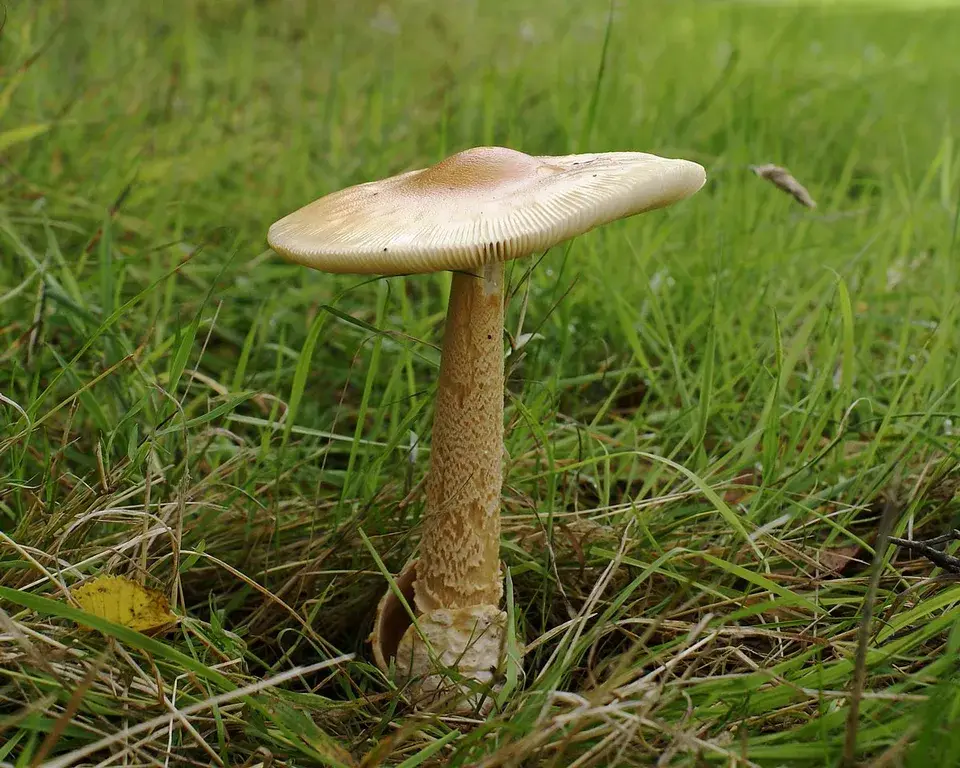
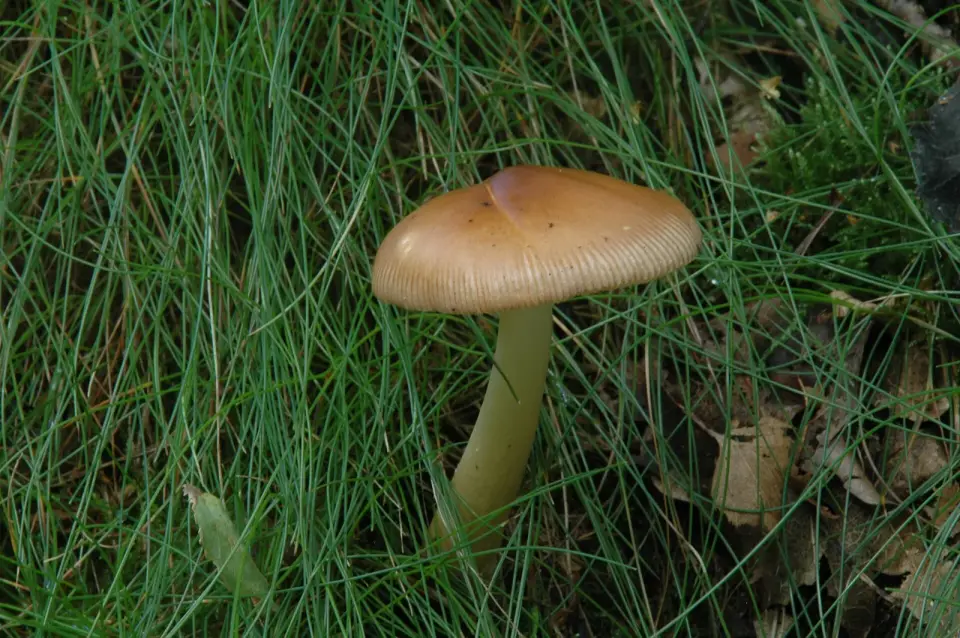
The orange grisette is a slender relative of the Amanita with a smooth, shiny, yellow-orange cap, a grooved margin and a lobed volva on the stem. It has no ring. It is considered edible, but is poisonous raw and, because of the risk of confusion with death caps, only for confident experts.
SeasonJune to November
Spore printwhite
FamilyAmanitaceae
Cap. The cap is 5 to 10 cm wide, conical to bell-shaped when young, later flat with a central bump. The cap skin is smooth, bald and shiny, yellow-orange to orange-brown, and the margin is distinctly grooved.
Underside. The gills are crowded, free from the stem and cream with a slight salmon to pink tinge.
Stem, ring and volva. The stem is 10 to 15 cm tall, slender and hollow with age, with a fine scaly or snakeskin pattern. It stands in a thick, sac-like volva that is whitish on the outside and cap-coloured inside. There is no ring.
Smell and taste. It has no characteristic smell or taste.
Flesh and colour change. The flesh is thin and fragile.
Lookalikes
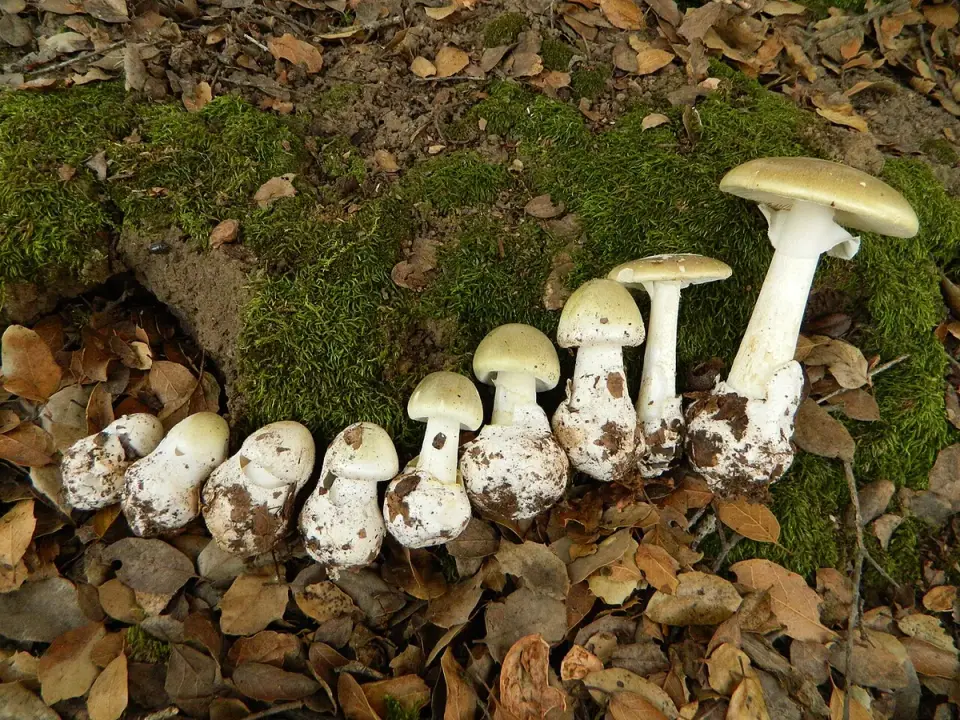
It has no ring, a grooved cap margin and a sac-like volva at the stem base. Deadly poisonous death caps, by contrast, have a smooth cap margin and a ringed stem, although the ring can be lost with age. Grisettes are poisonous raw and edible only when well cooked.
It has a ring on the stem, a smooth cap margin and a bulbous stem base with a volva. The strongest distinguishing feature: grisettes never have a ring and always have a grooved cap margin. Deadly poisonous.
It is slimmer and smaller and stands more often near conifers such as spruce, not near alder, ash, hornbeam, hazel or poplar. It too is edible only when well cooked.
It forms mycorrhiza only with birch. The spores are slightly more elongated and the cap skin of mature fruiting bodies is clearly two-layered, which can only be checked under a microscope.
View on the map →
Side by side
Swipe the table sideways
Orange grisette
Death cap
Tawny grisette
Amanita flavescens
Cap
yellow-orange to orange brown, 5 to 10 cm, margin grooved
olive to yellowish green, smooth margin, 5 to 15 cm
reddish brown to orange brown, grooved
pale yellow to yellowish, grooved
Underside
white to cream, free gills
white, free gills
white, free gills
white, free gills
Stem
slender, snakeskin pattern, sac-like volva, no ring
with hanging ring, bulbous base with volva
slender, snakeskin pattern, volva, no ring
slender, volva, no ring
Flesh
thin-fleshed, fragile
fleshy
thin-fleshed, fragile
thin-fleshed, fragile
Edibility
Edible with caution
deadly poisonous
edible with restrictions
edible with restrictions
Habitat & Season
Coniferous and deciduous woods, preferably near birches and on acidified soils. No reliable information.
Host trees
Birch, oak, alder, spruce, hornbeam, hazel and poplar.
Season
Jan
Feb
Mar
Apr
May
Jun
Jul
Aug
Sep
Oct
Nov
Dec
possible good main season
Mainly in summer.
Mushroom regions with a daily forecast
There are no records per region for this species yet. The country pages lead to all regions with a daily forecast.
How good are the chances of finding this species where you are right now? We calculate it from weather, soil moisture, altitude and forest at your location.
Mushroom advice:DGfM: find a mushroom expert. Certified mushroom experts of the German Mycological Society (DGfM).
Collecting rules: Mushrooms that are not specially protected may be collected in small quantities for personal use unless a protected area or ban applies. Certain specially protected edible species (e.g. cep, chanterelle, birch bolete) may be collected in small quantities for personal use.
Collecting rules: At most 2 kg of mushrooms per person per day unless the forest owner has prohibited collecting; organised collecting events are prohibited. Additional state rules apply (collecting hours, closed seasons), e.g. Carinthia, Tyrol, Vorarlberg, Salzburg.
Conservation and collecting rules
Not specially protected.
In the kitchen
Use only when well cooked; raw it is poisonous. Fry or steam cap and stem like other delicate mushrooms. Cook for at least 15 minutes.
No reliable information on drying. Poisonous raw, eat only when thoroughly cooked. Eat only if the lack of a ring and the grooved cap margin have been checked with certainty: a mushroom with a ring is not a grisette.
Never eat wild mushrooms raw, and always cook them for at least 15 minutes.
Use only young, fresh, maggot-free mushrooms that you have identified with certainty.
Carry mushrooms in an airy basket, not in plastic bags, and process them on the same day.
Frequently asked questions
Is the orange grisette edible?
Yes, it is used as an edible mushroom, but it is poisonous raw and edible only when well cooked. Because it can be mistaken for death caps, only confident experts should collect it.
How do I recognise the orange grisette?
By the smooth, yellow-orange cap with a grooved margin, the white free gills, the sac-like volva at the stem base and the lack of a ring.
What can it be mistaken for?
For other grisettes such as the tawny grisette and Amanita flavescens, which are also edible only when cooked. The deadly poisonous death caps are dangerous: they have a smooth cap margin and a ring on the stem, although it can be lost with age.
When does the orange grisette grow?
From June to November, mainly in summer, in deciduous and coniferous woods.