
Whitish funnel caps Clitocybe spp.
poisonousThey are mostly much smaller, and several species are poisonous. The strongest distinguishing feature is size: a cap of 25 cm or more points to the giant funnel. If in doubt, do not eat it.
No profile yet
No matching species found.
Aspropaxillus giganteus (Sowerby) Kühner & Maire · Tricholomataceae
Where is it growing now? Open the map Mushroom alert for this species How the mushroom alert works
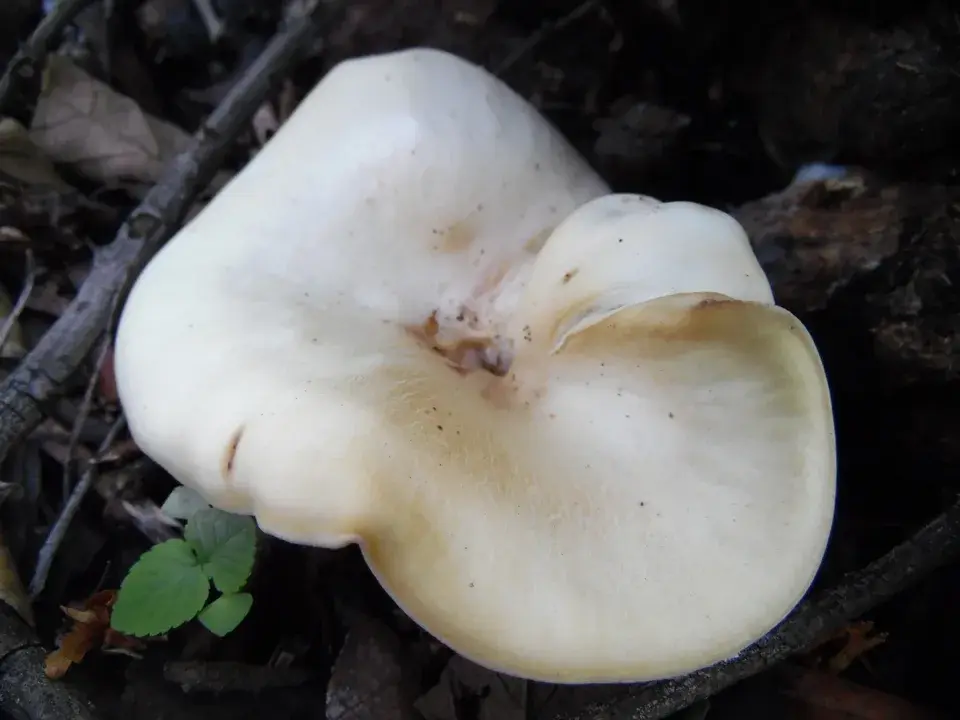
The giant funnel is a strikingly large, whitish to cream funnel cap whose cap can grow up to 60 cm wide. It often forms large fairy rings. It is considered edible when young, but not everyone can tolerate it.
It is a very large, whitish funnel cap with white spore print and can be mistaken for smaller, partly poisonous white funnel caps. It is considered edible when young, but is not tolerated by everyone.
They are mostly much smaller, and several species are poisonous. The strongest distinguishing feature is size: a cap of 25 cm or more points to the giant funnel. If in doubt, do not eat it.
No profile yet
Its stem flesh snaps with a crack like polystyrene or an apple, it is not fibrous, and it carries milk. The distinguishing feature is the brittle, splintering texture with milk. Inedible.
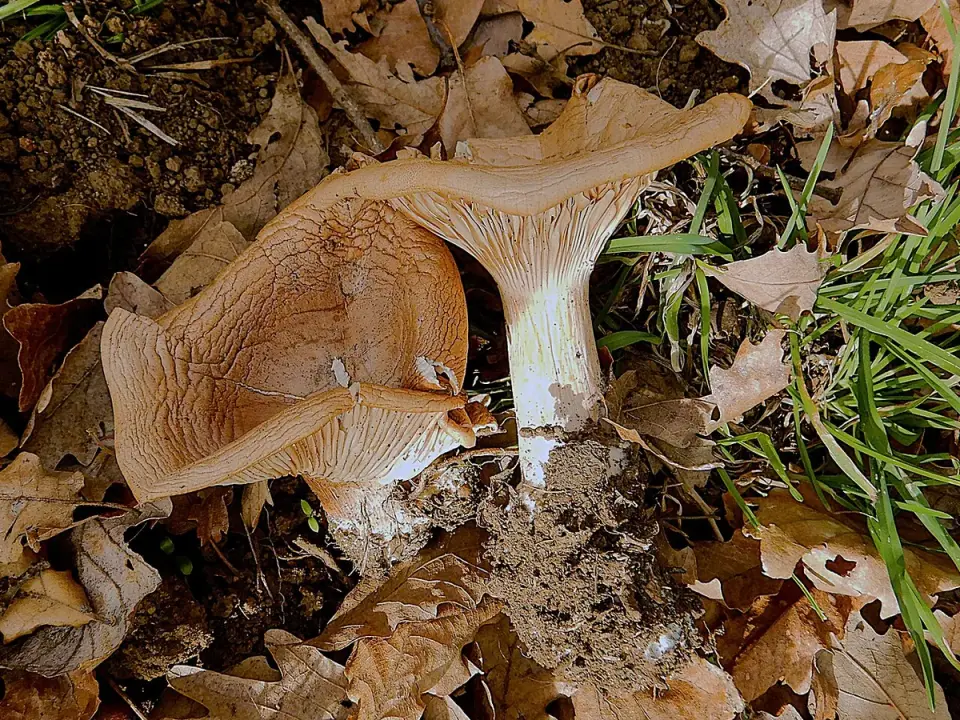
It reaches similar dimensions, but has a perceptible cap bump and a stem that is clearly longer in relation to the cap width. Also edible.
View on the map| Giant funnel | Whitish funnel caps | Fleecy milk-cap | Trooping funnel | |
|---|---|---|---|---|
| Cap | whitish to cream, funnel-shaped, 25 to 60 cm | whitish to pale, mostly under 10 cm | white, felty, funnel-shaped | large, cream to ochre brown, with bump |
| Underside | crowded, far decurrent, cream gills | decurrent, crowded gills | white, slightly decurrent gills, drip milk | decurrent, crowded gills |
| Stem | short, thick, fibrous whitish | slender, mostly fibrous | short, firm, snapping | long, sturdy, fibrous |
| Flesh | stringy, firm when young, later soft | thin-fleshed | brittle, snaps with a crack, milk | fleshy, fibrous |
| Edibility | Edible | poisonous | inedible | edible |
Fertile soils with organic remains, for example on pastures and forest clearings, often in large fairy rings. No reliable information.
No tree partner; it grows as a litter decomposer.
possible good main season
Rough estimate; the fruiting time depends on the weather.
There are no records per region for this species yet. The country pages lead to all regions with a daily forecast.
How good are the chances of finding this species where you are right now? We calculate it from weather, soil moisture, altitude and forest at your location.
Poison centre:
Emergency: 112 · 999
Poison centre:
Emergency: 112
Mushroom advice: DGfM: find a mushroom expert. Certified mushroom experts of the German Mycological Society (DGfM).
Collecting rules: Mushrooms that are not specially protected may be collected in small quantities for personal use unless a protected area or ban applies. Certain specially protected edible species (e.g. cep, chanterelle, birch bolete) may be collected in small quantities for personal use.
Poison centre:
Emergency: 112 · 144
Mushroom advice: Austrian Mycological Society (ÖMG): mushroom advice. Mushroom advice by the Austrian Mycological Society or regional services such as municipal market offices.
Collecting rules: At most 2 kg of mushrooms per person per day unless the forest owner has prohibited collecting; organised collecting events are prohibited. Additional state rules apply (collecting hours, closed seasons), e.g. Carinthia, Tyrol, Vorarlberg, Salzburg.
Not specially protected.
Use only young fruiting bodies, well cooked. Cut the caps into pieces and fry or stew them. Cook for at least 15 minutes.
No reliable information on drying. Not tolerated by everyone; nausea can occur if not heated enough. Use only young fruiting bodies.
It is considered edible when young. But not everyone tolerates it, and it can cause nausea, especially if not heated enough.
By the very large, funnel-shaped, whitish to cream cap of 25 to 60 cm, the gills running far down the stem, the short thick stem and the white spore print.
For smaller, partly poisonous white funnel caps, for the trooping funnel, which has a cap bump and a longer stem, and for white milk caps such as the fleecy milk-cap.
It grows as a litter decomposer on fertile soils, for example on pastures or forest clearings, and often forms large fairy rings.
No substitute for having your finds checked in person. No guarantee of accuracy. Updated: 17.10.2026.
