FungiFindFungiFind

FungiFind › Mushroom species

Mottled bolete

Leccinum variicolor Watling · Boletaceae

Where is it growing now? Open the map Mushroom alert for this species How the mushroom alert works

Identification in 5 steps

The mottled bolete is a scaber stalk that lives only with birches and prefers marshy, acidic sites. Its flesh turns pink and bluish in the air, and at the stem base it is often blue-green. It is edible, but rarer than the birch bolete and should be spared.

SeasonJune to October
Spore printyellowish olive to brownish
FamilyBoletaceae
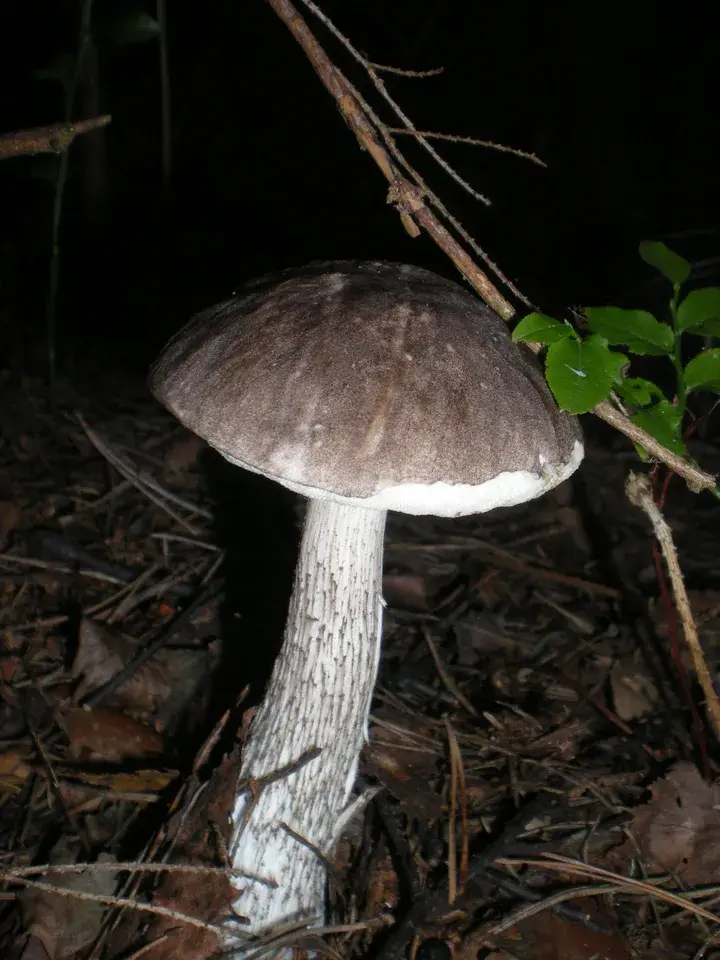
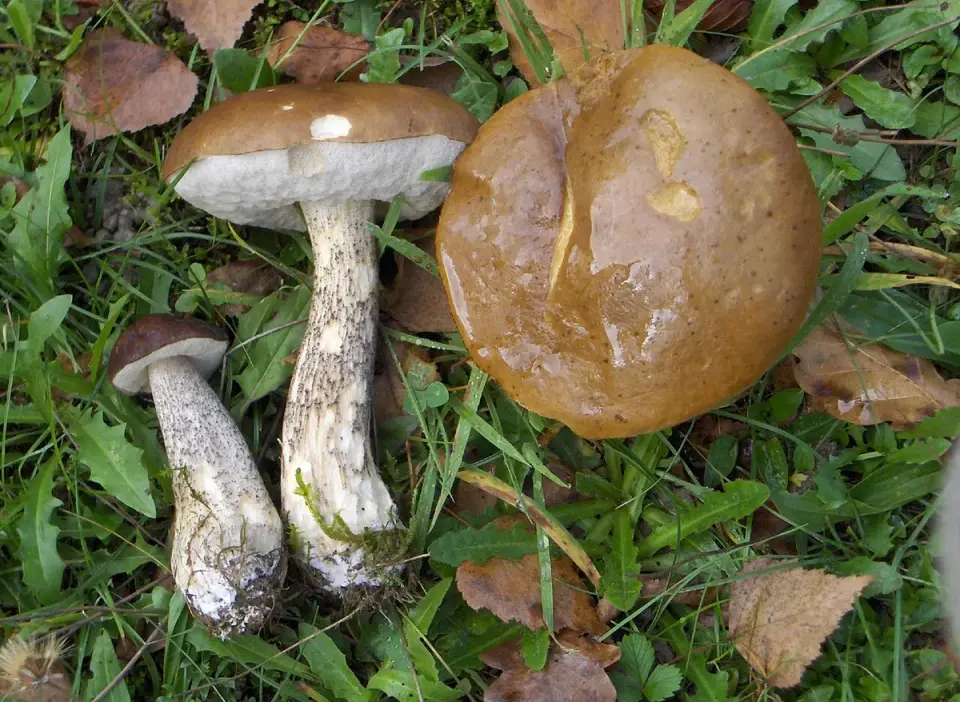
  1. Cap. The cap is 5 to 15 cm wide, at first hemispherical, later cushion-like. The cap skin is pale grey-brown to reddish brown, later often browner, smooth, bald, dry and rather slimy when damp.
  2. Underside. The tubes are white, pale pink or cream when young and later dirty cream. They are strongly depressed around the stem, and the tube layer detaches easily from the cap flesh.
  3. Stem, ring and volva. The stem is 5 to 15 cm long, 1 to 3.5 cm thick, slender, white and covered with dark to black scales. The stem base is often coloured green-blue. There is no ring and no volva.
  4. Smell and taste. The smell is unremarkable, the taste mild.
  5. Flesh and colour change. The flesh is whitish to cream, firm when young, later spongy. In the air it turns pale pink, later bluish colours appear. It turns black when cooked.

Lookalikes

It has tubes instead of gills and a white stem with dark scales, and grows near birches. All scaber stalks are edible, and the similar birch boletes are too. Raw, they are not tolerated.

Leccinum cyaneobasileucum

edible

It also has a stem base that turns blue; a safe separation in the field is usually possible only for experts. Also edible.

Side by side

Mottled boleteBirch boleteLeccinum cyaneobasileucum
Cappale grey-brown to reddish brown, 5 to 15 cm, slimy when damppale grey-brown to reddish grey-brown, 5 to 15 cmpale grey-brown
Undersidewhitish to cream-coloured tubeswhite, later grey tubeswhitish tubes
Stemwhite, dark-scaled, base often blue-greenwhite, dark-scaled, base not discolouredwhite, dark-scaled, base bluish
Fleshfirm when young, later spongy, flesh pink to bluishfirm when young, later spongy, flesh unchangingsoft, watery
EdibilityEdibleedibleedible

Habitat & Season

Marshy, acidic sites and bogs. It does not occur on calcareous soil. No reliable information.

Host trees

Birch only.

Season

possible good main season

It grows within the range of birch, preferring bogs and marshes.

Mushroom regions with a daily forecast

There are no records per region for this species yet. The country pages lead to all regions with a daily forecast.

All mushroom regions →

Chance near you

How good are the chances of finding this species where you are right now? We calculate it from weather, soil moisture, altitude and forest at your location.

View on the map

Safety

Never eat a mushroom you have not identified with certainty. Only eat mushrooms you have identified beyond doubt, and always cook them thoroughly.

Advice for your country

United Kingdom

Poison centre:

NHS 111 (England)111

Emergency: 999 · 112

Ireland

Poison centre:

National Poisons Information Centre (public line)(01) 809 2166

Emergency: 112 · 999

Germany

Poison centre:

Giftnotruf Berlin030 19240Giftinformationszentrum München089 19240GIZ-Nord Göttingen0551 19240

Emergency: 112

Mushroom advice: DGfM: find a mushroom expert. Certified mushroom experts of the German Mycological Society (DGfM).

Collecting rules: Mushrooms that are not specially protected may be collected in small quantities for personal use unless a protected area or ban applies. Certain specially protected edible species (e.g. cep, chanterelle, birch bolete) may be collected in small quantities for personal use.

Austria

Poison centre:

Vergiftungsinformationszentrale (VIZ)01 406 43 43

Emergency: 112 · 144

Mushroom advice: Austrian Mycological Society (ÖMG): mushroom advice. Mushroom advice by the Austrian Mycological Society or regional services such as municipal market offices.

Collecting rules: At most 2 kg of mushrooms per person per day unless the forest owner has prohibited collecting; organised collecting events are prohibited. Additional state rules apply (collecting hours, closed seasons), e.g. Carinthia, Tyrol, Vorarlberg, Salzburg.

Conservation and collecting rules

Because of its rarity, sparing the species is recommended.

In the kitchen

Use only young, firm mushrooms; older flesh becomes spongy and watery. The flesh turns black when cooked, which is normal. Cook for at least 15 minutes.

No reliable information on drying. Not tolerated raw. Better to spare it because of its rarity.

Frequently asked questions

Is the mottled bolete edible?

Yes, like the birch bolete it is edible. Because of its rarity, however, it should be spared.

How do you recognise it?

By the white, dark-scaled stem with an often blue-green base and the flesh that turns pale pink and later bluish in the air, in association with birches.

How does it differ from the birch bolete?

The flesh of the birch bolete is unchanging when broken, and the stem base does not turn blue.

Where does it grow?

Only near birches, preferably in bogs and marshes on acidic soils, from June to October.
Related species

Mushroom trainer: test yourself

Sources

Photo credits

No substitute for having your finds checked in person. No guarantee of accuracy. Updated: 17.10.2026.

Open the mushroom map