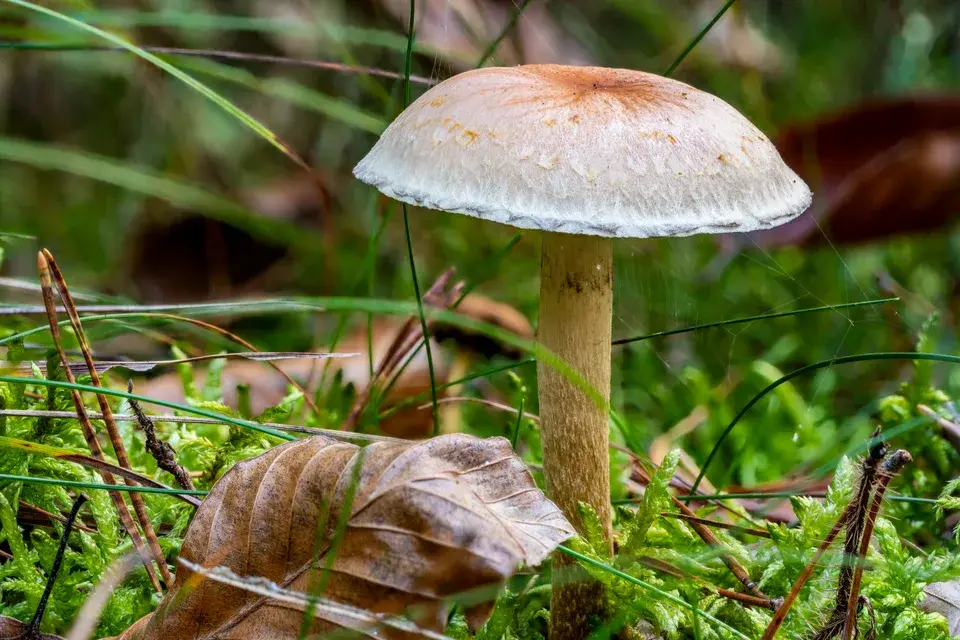
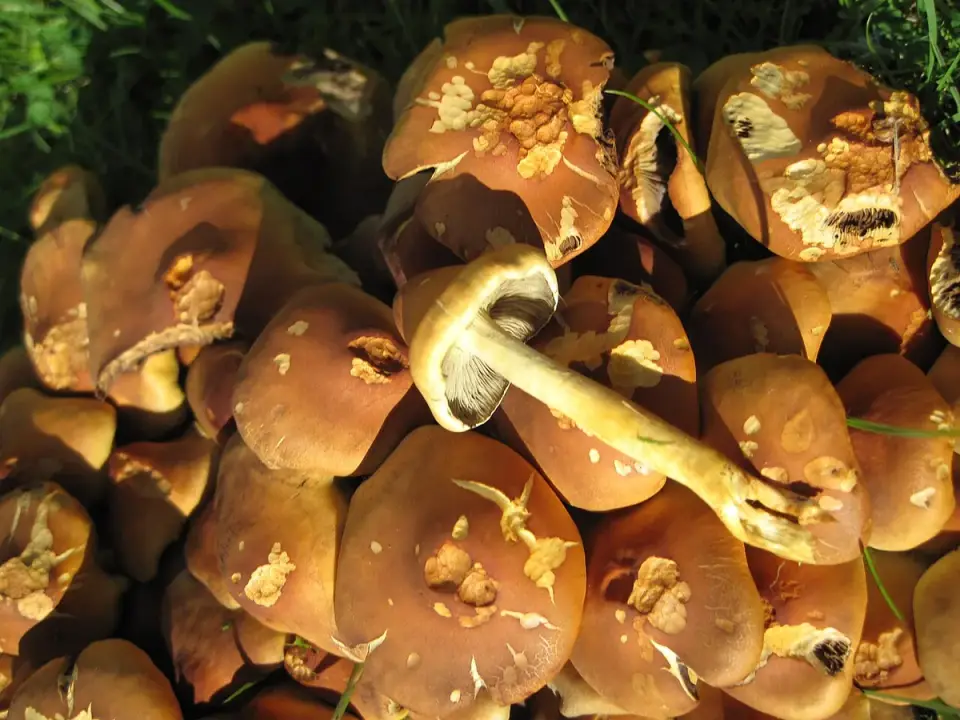
The conifer tuft grows in dense tufts on conifer stumps. Its cap is pale yellow to yellow-brown with a foxy centre, the gills are grey and the fruiting bodies taste mild. It is edible, but easily mistaken for the poisonous sulphur tuft.
SeasonSeptember to November
Spore printdark violet brown
FamilyStrophariaceae
Cap. The cap is 2 to 8, sometimes up to 10 cm wide, at first domed, later flattened, sometimes slightly bumped. It is pale yellow, soon yellow-brown, with a foxy reddish to foxy brownish centre. The surface is smooth, with thin, short-lived veil remnants on the margin.
Underside. The gills are first pale, then ash grey and grey-violet with age. Green tones are absent. They are attached to adnate to the stem and are almost crowded.
Stem, ring and volva. The stem is 5 to 8 cm long, hollow and bent because of the tufted growth. At the top it is whitish or pale yellowish, below yellow-brown to rust brown. In young mushrooms veil remnants can form a ring zone. There is no volva.
Smell and taste. It smells pleasant and tastes mild, not bitter.
Flesh and colour change. The flesh is thin, soft and whitish.
Lookalikes
It grows in tufts on conifer wood and has grey gills without a green tinge. The sulphur tuft is poisonous and has greenish gills, but tastes bitter. Safe identification is therefore necessary.
Its gills have greenish tones, sterile fruiting bodies bear bright yellow gills, and it tastes bitter. The strongest distinguishing feature is the greenish gills. Poisonous, causes gastrointestinal upset.
How good are the chances of finding this species where you are right now? We calculate it from weather, soil moisture, altitude and forest at your location.
Mushroom advice:DGfM: find a mushroom expert. Certified mushroom experts of the German Mycological Society (DGfM).
Collecting rules: Mushrooms that are not specially protected may be collected in small quantities for personal use unless a protected area or ban applies. Certain specially protected edible species (e.g. cep, chanterelle, birch bolete) may be collected in small quantities for personal use.
Collecting rules: At most 2 kg of mushrooms per person per day unless the forest owner has prohibited collecting; organised collecting events are prohibited. Additional state rules apply (collecting hours, closed seasons), e.g. Carinthia, Tyrol, Vorarlberg, Salzburg.
Conservation and collecting rules
Not specially protected.
In the kitchen
The caps are well suited to drying and as a seasoning; the stems are fibrous. Use only young caps and cook them well. Cook for at least 15 minutes.
The caps dry well and are used as a seasoning. Risk of confusion with the poisonous sulphur tuft.
Never eat wild mushrooms raw, and always cook them for at least 15 minutes.
Use only young, fresh, maggot-free mushrooms that you have identified with certainty.
Carry mushrooms in an airy basket, not in plastic bags, and process them on the same day.
Frequently asked questions
Is the conifer tuft edible?
Yes, it is edible and tastes mild. The caps are well suited to drying and as a seasoning. Take care because of the risk of confusion with the poisonous sulphur tuft.
How does it differ from the sulphur tuft?
The conifer tuft has grey gills without green tones and tastes mild; the sulphur tuft has greenish gills and tastes bitter.
Where does the conifer tuft grow?
In dense tufts on rotten stumps and roots, almost exclusively of conifer wood, especially spruce.
When does it appear?
Mainly from September to November, but all year round in suitable weather.