
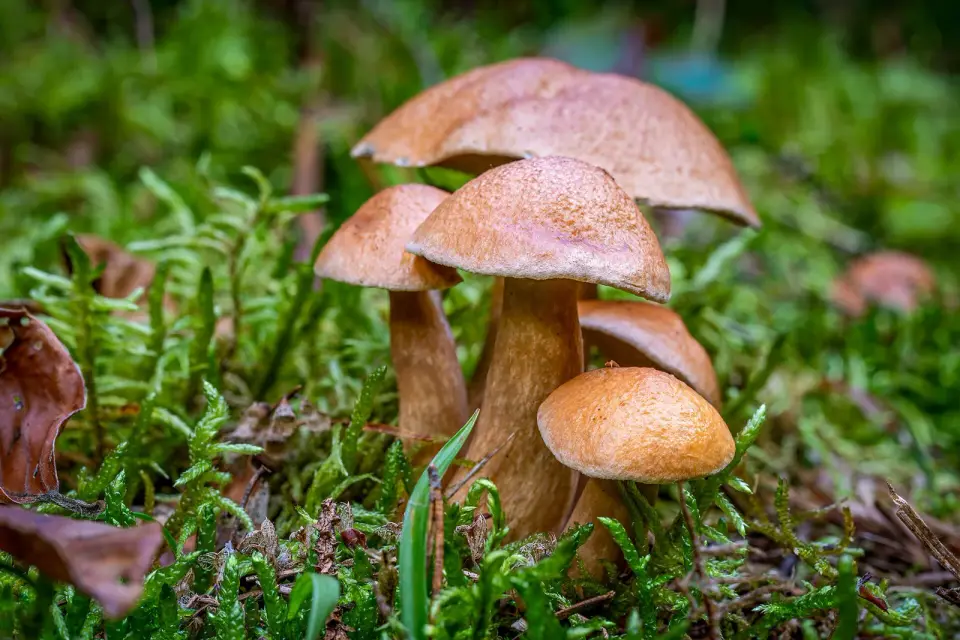
Brown roll-rim Paxillus involutus
poisonousIt has true, forked gills that can be separated from the cap, not tubes. The most reliable feature is the gills. Poisonous, especially when eaten repeatedly.
No matching species found.
Gyrodon lividus (Bull.) Sacc. · Paxillaceae
Where is it growing now? Open the map Mushroom alert for this species How the mushroom alert works
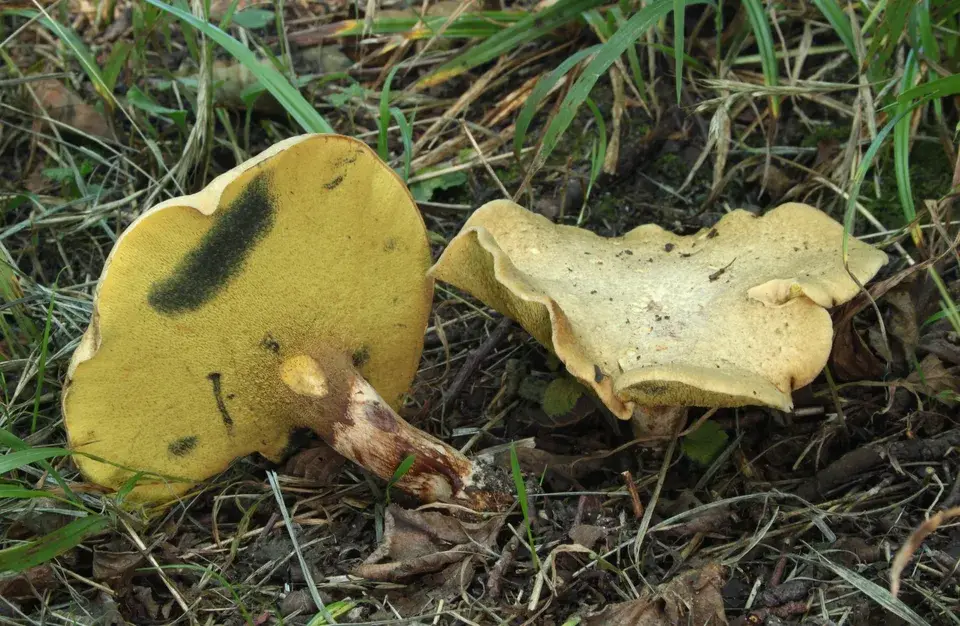
The alder bolete is a yellowish to ochre-brownish bolete with a felty cap and a short, curved stem that grows only near alders. It is edible, but has little culinary value and is specially protected.
It grows near alders and has tubes instead of gills, which run down the stem and turn blue under pressure. The poisonous brown roll-rim, by contrast, has true gills. The alder bolete has little culinary value.
It has true, forked gills that can be separated from the cap, not tubes. The most reliable feature is the gills. Poisonous, especially when eaten repeatedly.
It grows near pines, has a slimy cap skin and wide pores. The alder bolete grows near alders, has a dry, felty cap and narrow, barely visible pores. Also edible.
View on the map| Alder bolete | Brown roll-rim | Bovine bolete | |
|---|---|---|---|
| Cap | yellowish to ochre-brownish, 3 to 12 cm, finely felty, dry | yellow-brown to olive brown, margin rolled in for a long time | yellow-brown, slimy |
| Underside | golden-yellow decurrent tubes, turn blue under pressure | decurrent, forked gills, can be detached | large, wide pores, decurrent |
| Stem | short, curved, cap-coloured | short, brown, sensitive to pressure | short, yellowish |
| Flesh | soft, flesh turns blue | soft, moist | soft |
| Edibility | Edible | poisonous | edible |
Damp, marshy sites where alders grow. No reliable information.
Alder, with which it forms mycorrhiza.
possible good main season
Sometimes in large numbers.
There are no records per region for this species yet. The country pages lead to all regions with a daily forecast.
How good are the chances of finding this species where you are right now? We calculate it from weather, soil moisture, altitude and forest at your location.
Poison centre:
Emergency: 112 · 999
Poison centre:
Emergency: 112
Mushroom advice: DGfM: find a mushroom expert. Certified mushroom experts of the German Mycological Society (DGfM).
Collecting rules: Mushrooms that are not specially protected may be collected in small quantities for personal use unless a protected area or ban applies. Certain specially protected edible species (e.g. cep, chanterelle, birch bolete) may be collected in small quantities for personal use.
Poison centre:
Emergency: 112 · 144
Mushroom advice: Austrian Mycological Society (ÖMG): mushroom advice. Mushroom advice by the Austrian Mycological Society or regional services such as municipal market offices.
Collecting rules: At most 2 kg of mushrooms per person per day unless the forest owner has prohibited collecting; organised collecting events are prohibited. Additional state rules apply (collecting hours, closed seasons), e.g. Carinthia, Tyrol, Vorarlberg, Salzburg.
Specially protected under the German Federal Species Protection Ordinance (Bundesartenschutzverordnung), according to Wikipedia. Leave it standing.
The culinary value is low. If at all, use only young, firm mushrooms and cook them well. Cook for at least 15 minutes.
No reliable information on drying. Low culinary value. Specially protected, not meant for collecting.
It is edible, but has little culinary value. It is also specially protected under the German Federal Species Protection Ordinance (Bundesartenschutzverordnung), so it is better left standing.
By the yellowish to ochre-brownish, felty cap, the tubes running down the stem and turning blue under pressure, and its growth near alders.
For the poisonous brown roll-rim, which has true gills, and for the bovine bolete, which grows near pines and has a slimy cap.
From August to October, sometimes in large numbers, at damp sites near alders.
No substitute for having your finds checked in person. No guarantee of accuracy. Updated: 17.10.2026.
